 Credit Score Education
 Credit Reporting & Consumer Rights
 Personal Finance Tips
 Budgeting & Money Management
 Identity Theft & Fraud Prevention
 Credit Card Education
 Consumer Financial News
 Cost of Living & Inflation
 Banking & Savings Education
 Consumer Protection & Financial Literacy

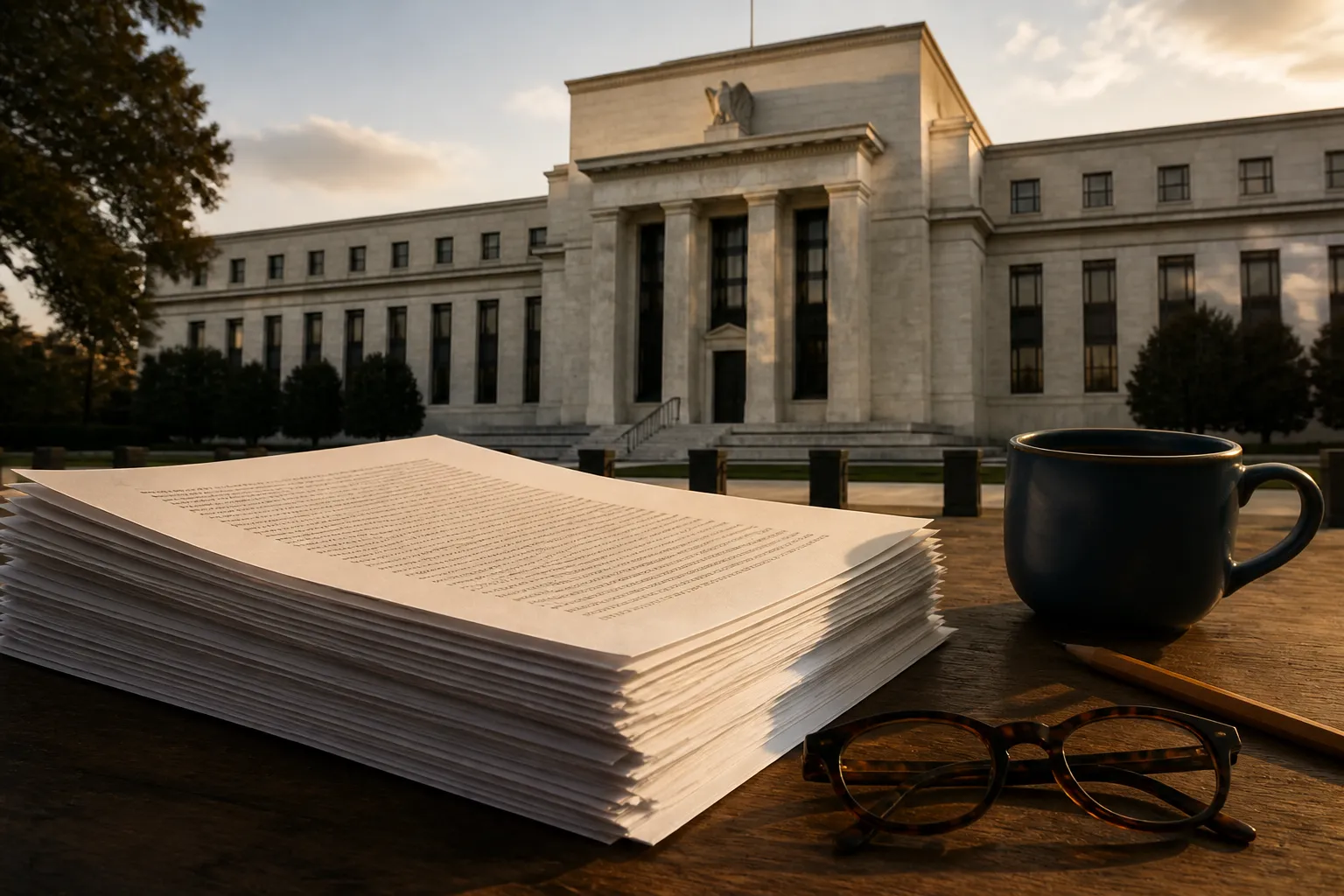
Every six weeks or so, the Federal Open Market Committee meets, releases a statement, and the financial press treats it like a weather event. Charts move, anchors raise their eyebrows, somebody says the word "hawkish" on television as if it explains anything. What actually happened in that room gets compressed into a headline, and the headline is doing a lot of work it was not built to do.
What the Fed publishes after a meeting
The Federal Reserve describes itself as the central bank of the United States, tasked with keeping the monetary and financial system safe, flexible, and stable. That is the mission statement version. The paperwork version is more specific: after each FOMC meeting, the Fed issues a statement, and the Board of Governors posts an implementation note alongside it. Both show up on the Board's website with a title and a date, which sounds like a small thing until you realize how often a news summary substitutes for the actual document.
The record available for this piece shows us those titles and dates clearly enough, an October 2026 statement and its companion implementation note among them, but not the full text of what the Committee said. That gap matters more than it sounds like it should. The specific wording of a statement, which phrases got added or dropped from the last one, is often the real decision. A headline can tell you that rates moved or stayed put. It rarely tells you how the Committee hedged its own confidence.
Before trusting any of it, it helps to check the Fed's own meeting calendar. That one step answers a surprisingly common source of confusion: whether a story is describing a decision just made or recycling reaction to one from weeks earlier.
Why the press conference gets so much attention
If the statement is the fine print, the chair's press conference is the explainer video. A 2026 Brookings survey of Fed watchers, fielded in the spring of that year, found that nearly all respondents considered the post-meeting press conference the single most useful form of Fed communication. That finding lines up with how coverage actually behaves. Reporters wait for the chair to speak because the spoken answers, hedged and careful as they usually are, feel more like an explanation than the statement's dry legal language does.
The same survey found that nearly all respondents wanted the chair to keep holding these press conferences after every meeting. Brookings also flagged something less tidy: the incoming chair has reportedly questioned whether the practice is worth keeping. So a ritual that coverage often treats as permanent is, at the institutional level, still up for debate. That is worth remembering the next time a story describes the press conference as simply how things are done.
For a consumer trying to make sense of a Fed headline, the useful move is to separate the explanation from the decision. The chair's remarks are commentary on the statement, not a replacement for it. Reading both, even briefly, tends to reveal whether a headline captured the substance or just the best soundbite.
Why inflation expectations appear in the news
Consumer inflation expectations get a lot of airtime because they are not just a measurement, they are an input. Households base spending decisions on what they expect prices to do, and businesses base pricing on similar guesses. The Federal Reserve Bank of New York runs a Survey of Consumer Expectations for exactly this reason, and the Fed more broadly watches several such surveys, partly because it is trying to shape those expectations through both policy moves and public communication.
Here is where a lot of coverage gets ahead of the evidence. Researchers studying these surveys note that with monthly data, it is genuinely difficult to isolate whether a specific rate announcement moved consumer expectations at all. Other economic news in the same stretch of time, gas prices, a jobs report, an unrelated headline about tariffs, can shift the same numbers. Attributing a change to one Fed meeting is often a cleaner story than the data actually supports.
There is a second wrinkle. The Fed itself factors inflation expectations into its policy decisions, which means expectations are simultaneously something the Fed reacts to and something it is trying to influence. That loop makes cause and effect hard to pin down from the outside, and it is a good reason to read confident claims about what one announcement "did" to consumers with some patience.
How to read a Fed headline without overreading it
A workable habit starts with the primary documents. The Board's press release and its implementation note are posted the same day as the meeting, and they are more reliable than any same-day summary written around them. Cross-check the date against the Fed's published meeting calendar so you know which decision a story is actually describing.
From there, a few questions tend to separate solid coverage from noise.
- Is the claim about a survey trend over time, or about a single announcement's effect? Those are different kinds of evidence.
- Could other economic news from the same month explain a shift in expectations just as well as the Fed meeting could?
- Does the story treat the press conference as a fixed institutional habit, or does it note that its future is actually being debated?
Headlines that assign a specific consumer behavior change to one Fed announcement deserve a second look, since researchers say that link is hard to establish with the data available. For background written in plainer language, the St. Louis Fed publishes an explainer on how the Fed implements monetary policy, and the Fed's own site offers consumer help resources, useful if your question is about a Fed-supervised institution rather than a news cycle.
What these sources do not tell us
Worth saying plainly: the materials behind this piece do not include the actual text of the October 2026 statement or its implementation note, so no claim here describes what that specific decision said or how its language shifted from the prior meeting. For that, the Board's posted documents are the place to look.
These sources also do not address what any rate decision means for mortgage rates, credit card APRs, savings account yields, or loan terms. Those are separate, fast-moving questions that call for current figures from official sources, not inference from a communications survey. Anyone making a near-term borrowing or saving decision should check current numbers directly rather than reasoning backward from a Fed headline.
Finally, the 2026 Brookings survey material available here is limited to its opening findings, and a related 2025 research paper referenced in the broader literature was not accessible in usable form for this piece. If you see either cited with more specificity elsewhere, it is worth checking the original before repeating it. For general consumer protection questions tied to financial institutions, the CFPB and FTC remain the more direct resources than any single news cycle about the Fed.
Please seek a professional. This article is general information, not financial, tax or insurance advice. Please seek a licensed financial, tax or insurance professional about your own situation.


